What Is Cabling Certification and Why Is a Network That Powers Up Not Enough?
Cabling certification measures every link against its category limits. Which parameters fail a copper link and when to certify a plant already running.
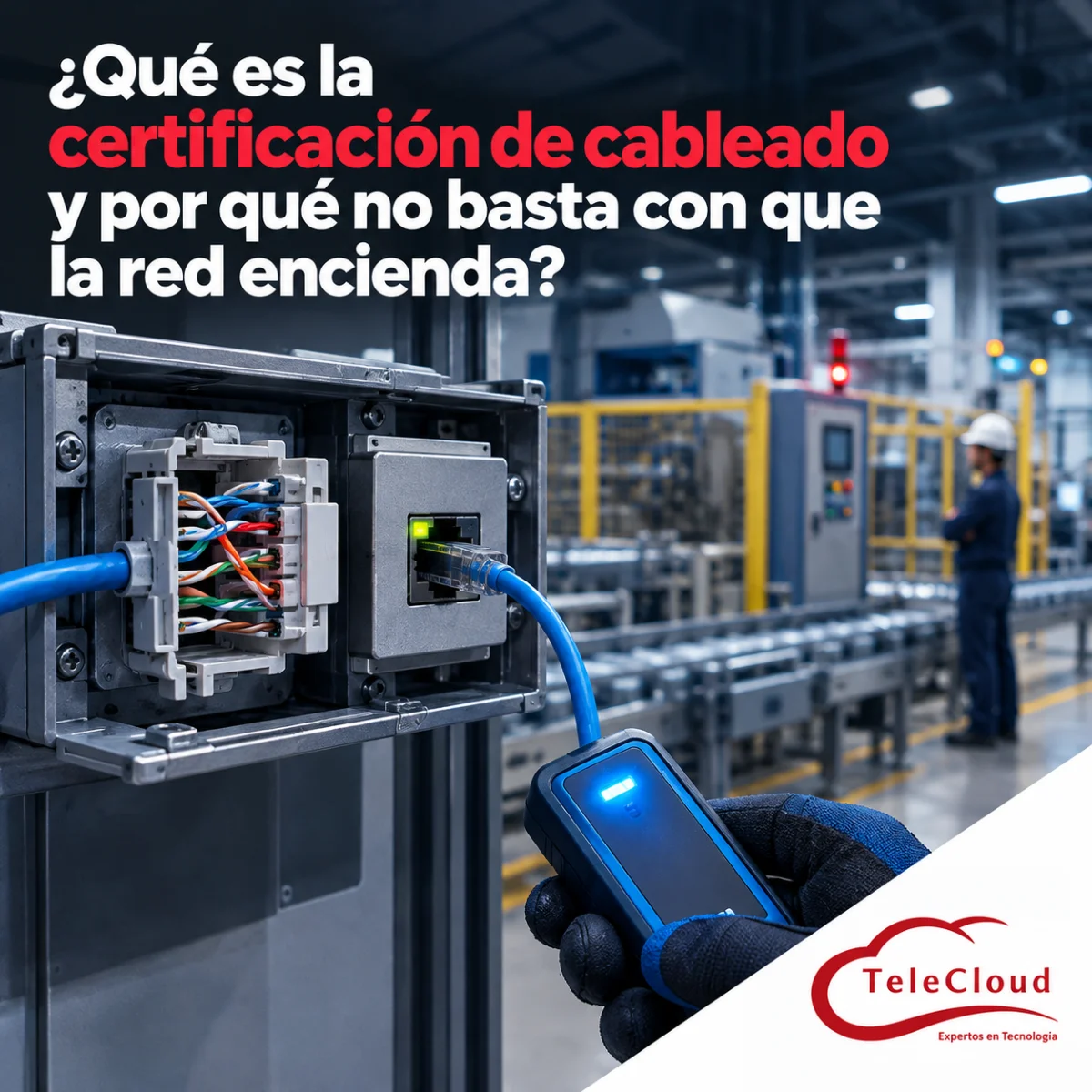
The new stamping line started up on the committed date. The network contractor connected every drop, checked that each one showed a link and handed over the job with a sign-off sheet. A few weeks later, the remote I/O modules lose communication with the PLC for a few seconds, two or three times per shift. Each dropout stops the line for safety reasons, the parts in process go to scrap and the restart takes almost half an hour. The line integrator blames the network; the contractor replies that every point lit up on delivery day, and without a report there is no way to hold anyone accountable. Three weeks later, a certifier finds the cause in minutes: a split pair at the drop on the main control panel and a link that exceeds the allowed length. By then, the plant has already paid several times what certification would have cost at the start, in scrap and downtime.
Cabling certification measures every link with a certification tester against the limits of its category in TIA-568 and delivers a per-point report. That way you know how much margin your network has before you put it to work.
What a link that powers up can hide
When the port LED lights up, all you know is that two devices managed to negotiate a connection at that moment. If the cable cannot sustain the highest speed both support, they can drop to a lower one without telling anyone, or hold it with errors that the network corrects by retransmitting the data. On a computer, that shows up as slowness. In the cyclic communication between a PLC and its remote I/O, a few lost packets in a row are enough for the controller to treat the connection as lost and stop the process.
On top of that, on delivery day the plant had no motors running, the cable bundles were cold and nothing was powered by PoE. A link that barely passes that day loses its margin when the cable tray heats up, a nearby variable frequency drive starts or a high-power camera is connected.
Verify, qualify and certify: three tests with different scopes
Three types of instruments are used in the field. The verifier, the continuity tester that almost every installer carries, confirms that all eight wires reach the other end in the correct order. The qualifier indicates whether a link can carry a specific application, such as 1 Gb/s Ethernet, at that moment. The certifier measures the electrical parameters of the link across the full frequency range of its category, compares them with the TIA-568.2 limits and issues a pass or fail result with its margin. That result is the one used as evidence to accept a job.
Margin: the reserve that decides how much the link can take
For each parameter, the certifier reports how much headroom the link has relative to the limit at the most critical point of the measurement. Two links can pass on the same day, one with ample headroom and the other right at the limit. The first tolerates heat, PoE, a lower-quality patch cord and the passing of the years; the second is a candidate for intermittent failure as soon as any of those conditions changes. The margins in the report tell you which points to watch before you connect critical equipment to them.
The parameters that fail a copper link and what each one reveals
Each failed parameter points to a different type of defect, which is why the report also works as a diagnostic tool.
Wire map: open, crossed and split pairs
The first test checks the continuity of all eight conductors and, in shielded cable, of the shield. It detects open wires, shorts, reversed, crossed and split pairs. The split pair is the most deceptive: each wire reaches its correct position, but two of them travel in different twisted pairs and lose the cancellation that the twist provides. A continuity tester passes it; the certifier detects it because it measures the coupling between pairs.
Length and delay: distance measured in nanoseconds
The certifier calculates length from the time it takes a pulse to travel out and back along each pair. Using the same principle, it measures propagation delay and delay skew between pairs, which matters because 1 and 10 Gb/s Ethernet transmit over all four pairs at once and the receiver needs the four parts of the signal to arrive almost together. A permanent link longer than 90 meters fails even if the devices power up.
Insertion loss: the signal lost along the way
Insertion loss, formerly called attenuation, is the signal lost from one end to the other. It increases with length, frequency and temperature. It fails on links that are too long, in bundles heated by PoE and in copper-clad aluminum cables, whose conductors have more resistance than solid copper ones.
NEXT, PSNEXT and ACR-F: the crosstalk one pair induces on another
Near-end crosstalk (NEXT) measures how much of the signal from one pair leaks into another near the transmitting device, and it is measured from both ends. PSNEXT adds up the effect of the other three pairs on each one, and ACR-F compares the crosstalk that reaches the far end with the useful signal. Most NEXT failures originate in the termination: pairs untwisted too far, connectors of a lower category or a poor-quality patch cord. Current certifiers show the distance at which the problem occurs, so the technician knows whether to redo a connector or check a section of cable.
Return loss: the signal that bounces back
When impedance changes along the link, part of the signal travels back toward the transmitter and interferes with the signal moving in the opposite direction. It is caused by components with different impedances in the same channel, cables crushed by cable ties, tight bends and poorly made terminations.
Resistance and unbalance: what matters when PoE is involved
Current certifiers also measure the DC resistance of each pair and the resistance unbalance between conductors. PoE sends current over the data conductors themselves; if one has more resistance than its partner because of a bad termination, the current is split unevenly, it can corrupt the data and it heats up the faulty contact. If your plant powers equipment over PoE, these measurements matter as much as crosstalk.
Testing mistakes that leave your plant with a useless report
A report with every point passing can be worthless if the test was done wrong. If a Cat6A installation is tested against the Cat5e limit, almost any link passes and the category you paid for remains unproven. If the configured nominal velocity of propagation differs from that of the cable, the lengths come out wrong. A certifier without current calibration produces results that a manufacturer or an auditor can reject. And certification covers 100 % of the links, because termination defects appear at isolated points that a sample can miss.
What a reliable certification report should include
Before you sign off on a job, check that the report includes:
The identifier of each link, matching its label on the patch panel and at the outlet.
The test limit and the cable type, which must match the contracted category.
The serial number and calibration date of the certifier.
The result for each parameter, with the worst-case margin and the measured length.
The original file from the certifier's software, in addition to the PDF.
Fiber optics: the backbone gets certified too
In fiber, basic certification measures the loss of each link with a light source and a power meter, compares it with the loss budget and confirms length and polarity; on critical backbones, an OTDR test is added, as provided for in the TIA-568 standard.
What often gets skipped is connector inspection. A single dust particle on a connector's end face is enough to raise the loss or scratch the connector it mates with. Before testing and before connecting each patch cord, connectors are checked with a fiber microscope and cleaned, a step that in a plant with process dust prevents many failures blamed on the equipment.
When to certify the cabling in a plant that is already running
Acceptance certification is done when a job is finished, before signing off on delivery. In a plant that is already running, there are other moments when certification makes sense:
When receiving an installation done by third parties, including one by a civil works or electrical contractor.
Before connecting 10 Gb/s switches, next-generation access points or high-power PoE devices.
When a device loses communication intermittently and checking the active equipment does not reveal the cause.
After moving a line or doing construction work near the cable trays.
Before a customer audit that asks for evidence of the infrastructure.
On the stamping line from the opening, that test would have found both defects before startup.
How we certify cabling at TeleCloud
At TeleCloud we certify every point we install before closing the project: we configure the test limit and cable type for the contracted category, test 100 % of the copper and fiber links, and correct anything out of specification on the spot. At closeout we deliver the per-point report, the labeling and the technical documentation.
We also certify existing cabling, for an audit, to accept a job done by third parties or to find the cause of a port that drops intermittently, with our own staff and engineering support. With a support contract, the technician arrives in 4 hours, 8 hours or the next business day, depending on how critical your operation is.
If your plant's cabling was accepted on the basis of "every point powers up," today you do not know how much margin each link has left. At TeleCloud we certify every point against the limits of its category, correct anything out of specification and deliver a report you can defend before a manufacturer or an auditor. Request a diagnosis of your network
Frequently asked questions
Does certification require disconnecting equipment from the line?
Yes. Each link is tested disconnected from the switch and from the end device, because the certifier occupies both ends. In a plant that is running, certification is scheduled by zones and in windows agreed with production; each point is out of service only during its own test.
What should I do with a link that passes with a very low margin?
Some certifiers flag with an asterisk results so close to the limit that they fall within the instrument's accuracy range. A link like that passes, although it is worth reviewing before connecting critical equipment or high-power PoE to it. The margin is often recovered by redoing the termination or replacing a patch cord.
Can the same installer certify their own work?
Yes, and that is the norm. What protects your plant is a verifiable report: the equipment's serial number and calibration, the correct limit and the original file for each test. If you want an additional check, ask to be present when a sample is tested or hire a third party to repeat it.
Do you need a network diagnosis?
The TeleCloud team evaluates your current infrastructure and proposes solutions adapted to your industrial operation.
Schedule free diagnosis