What Is a Telecommunications Room, and How Do the MDF and IDFs Differ?
The telecom room houses your network equipment and cabling. The MDF is the main room, and IDFs are zone rooms that serve the nearby outlets.
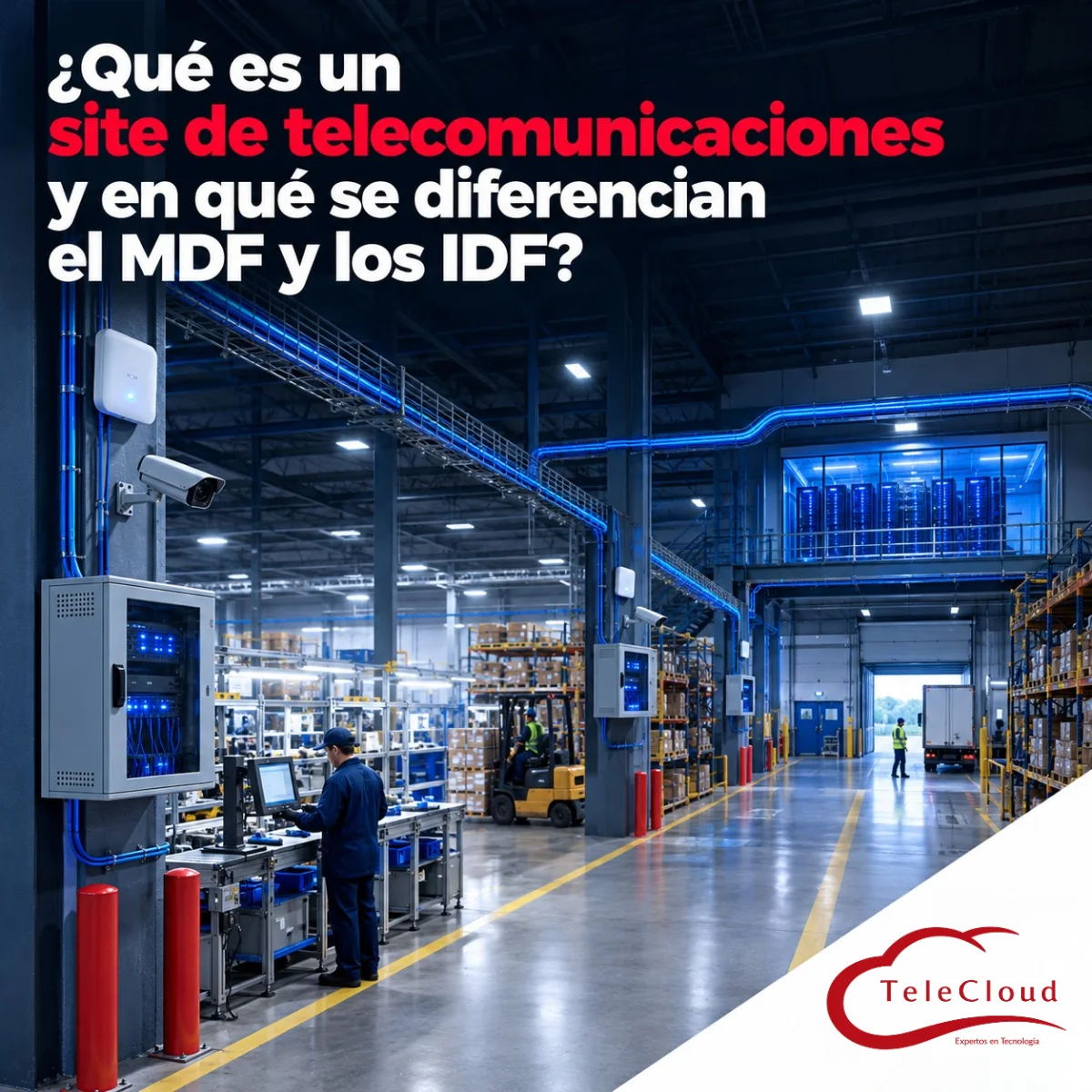
On a Friday night, the mini-split in the telecommunications room stops cooling. The room is next to the cafeteria, shares space with old archive boxes and cleaning supplies, and the air conditioner is the same office model installed when the plant had half as much equipment. The room stays closed and unchecked all weekend. On Sunday afternoon, the core switch shuts down from overheating, and with it every enclosure in the building goes offline, along with the cameras, the phones and the label printers in shipping. On Monday, the first shift starts with no access to the system and no labels, and the trucks wait in the yard while the IT staff restarts equipment and hunts down a fan. The network for the entire plant depended on a room nobody had designed for that job.
The telecommunications room concentrates your network's equipment and cabling. The MDF is the main room, with the service entrances and the core; IDFs are zone rooms that serve the nearby outlets.
When the whole plant depends on a room nobody designed
In many plants, the telecom room was born in whatever space was left over: a room under the stairs, a corner of the IT area or an office storeroom. Over the years, the core switch, the internet providers' links, the servers and the fiber arriving from every zone ended up there. The room grew in importance without growing in conditions.
A room shared with other uses
When the telecom room shares space with archives, cleaning or maintenance, people who do not know the equipment walk in, dust builds up and risks unrelated to the network appear: a wet mop, a box leaning against a rack, a water pipe running across the ceiling. Any one of them can stop the network for the entire plant.
Office air conditioning for a continuous load
Network equipment runs 24 hours a day and produces heat constantly. A comfort air conditioner, designed for offices, shuts off with the building, is programmed for business hours or falls short when equipment is added. Without temperature monitoring, the failure is discovered when the core switch shuts down to protect itself.
Power without enough backup
A telecom room connected to the same circuit as the offices, with a UPS (uninterruptible power supply) sized for the load of years ago, leaves the plant without a network at the first long outage. If the zone rooms have no backup either, the network goes down in pieces even while the main room stays on.
What a telecommunications room is and what it contains
The telecommunications room is the space that concentrates the network's active and passive infrastructure: racks, patch panels, fiber optic distribution frames, switches, routers, the firewall, servers when there are any, UPS units, the telecommunications grounding busbar and the cooling that keeps everything at a stable temperature. The cabling from every zone and the services coming from outside converge there.
What the standard calls these spaces
MDF and IDF are common industry terms. TIA-569, the standard for telecommunications pathways and spaces, uses other names: the entrance room, where the providers' services arrive; the equipment room, which houses the core equipment; the telecommunications room, which serves the outlets of a zone; and the telecommunications enclosure, a compact version for small areas. In practice, the MDF combines the entrance room and the equipment room, and each IDF corresponds to a telecommunications room or enclosure.
MDF and IDF: how they differ
The MDF (main distribution frame) and the IDFs (intermediate distribution frames) form a hierarchy. The MDF is the center of the plant's network, and each IDF is a distribution point that serves one zone.
The MDF: service entrances, core and backbone
The links from internet and phone providers arrive at the MDF, and the core switch, the firewall, the routers and, often, the servers are installed there. The backbone also ends there: the fiber optic cable coming from each IDF terminates in a fiber distribution frame, identified strand by strand. If the MDF goes down, communication between zones and with the outside world is lost.
IDFs: zone rooms that serve the nearby outlets
Each IDF holds the patch panels for its zone's horizontal cabling and the access switches that connect computers, cameras, access points, production terminals and controllers. Its location depends on distance: every outlet must stay within the 90 meters of permanent link set by TIA-568. When a zone is farther away, it needs its own IDF.
Star topology: every IDF runs back to the MDF
TIA-568 organizes the backbone as a hierarchical star: each IDF connects to the MDF with its own link, usually fiber optic, and the standard limits the intermediate levels between them. Chaining one IDF behind another means a failure in the first one takes down both, and it concentrates the traffic of several zones on a single link.
How many IDFs a plant needs
The number depends on floor area, the layout of the areas and the number of floors. TIA-569 recommends at least one telecommunications room per floor, and more when distance or floor area requires it. In an industrial building, the practical approach is to measure the real cable route from each possible location to the farthest outlets, and place the IDFs where all of them stay within the limit.
The requirements that turn a room into a reliable telecom room
TIA-569 describes the conditions these spaces must meet, and TIA-607 and TIA-606 cover grounding and identification. Their recommendations come down to five areas.
Location and exclusive use
The telecom room should be away from water sources, such as restrooms, pipes or leaking roofs, and away from transformers, motors and large electrical panels that generate interference. It should be a space for exclusive use, with access for moving equipment, clearance in front of and behind each rack, and reserve space for growth.
Continuous cooling
The telecom room's cooling runs 24 hours a day, all year, with capacity calculated for the heat the equipment produces and for the expected growth. It is best kept independent of the building's air conditioning, with temperature monitoring and an alarm, and with a second unit in critical rooms so the space keeps its cooling while the first one is under maintenance.
Power with backup
The telecom room needs dedicated circuits, a UPS with enough runtime to cover the startup of the generator or an orderly shutdown, and separate outlets for each power supply of critical equipment. Each IDF needs its own backup, sized for its switches and for the PoE (Power over Ethernet) devices it powers, such as cameras and access points.
Grounding and equipotential bonding
TIA-607 calls for a primary telecommunications grounding busbar in the MDF and a secondary busbar in each IDF, joined by a dedicated conductor and connected to the building's grounding system. Every rack, enclosure and cable tray is bonded to that busbar. With that equipotential network, a surge finds a safe path and equipment in different rooms shares the same electrical reference.
Controlled access and documentation
The telecom room door stays closed, with access only for authorized staff and a record of who goes in. Inside, every rack, panel and port carries its identifier according to TIA-606, and the room drawing shows the location of the equipment, the backbone routes and the power circuits.
Plant IDFs: enclosures next to production
In an industrial building, many IDFs are telecommunications enclosures mounted on a column or a wall, close to the lines they serve. There they face dust, humidity, vibration, heat and passing forklifts. An office cabinet in that environment gets dirty, overheats and is exposed to impacts.
A plant IDF needs an enclosure with a protection rating suited to the environment, filtered ventilation or its own cooling, a UPS for its switches, bonding to the telecommunications ground and a location protected from forklift traffic. It must also stay accessible for maintenance, without forcing the technician to climb a ladder in the middle of an aisle.
How we design your plant's telecom room and IDFs at TeleCloud
At TeleCloud we start with an on-site survey: we review the current room, measure the real distances to each zone and define where the MDF should go and how many IDFs your operation needs. With that design, under TIA/EIA standards, we install the fiber backbone, Cat6 or Cat6A horizontal cabling, pathways, grounding, power backup and the telecom room's cooling.
The installation is carried out by our own staff, in blocks and during the windows we agree on with production. At closeout we certify every link and deliver the documentation for the telecom room and each IDF. If your plant already runs on an improvised telecom room, we migrate it in stages, with monitoring and support under response times agreed by contract.
If your plant's network depends on a shared room, an office mini-split or enclosures without backup on the plant floor, a temperature or power failure can stop every area at once. At TeleCloud we design and install your plant's telecom room and IDFs under TIA/EIA standards, with a fiber backbone, grounding, power backup and cooling. Request a diagnosis of your network
Frequently asked questions
Does a small plant need IDFs?
It depends on distance. If every outlet stays within the 90 meters of permanent link from the MDF, a single room can serve the whole plant. When there are farther zones, another building or an expansion, each one needs its own IDF with a fiber link to the MDF.
Can the servers be in the same room as the MDF?
Yes, and it is common in midsize plants: the MDF also works as the equipment room. In that case, cooling, power and backup are calculated with the server load added to the network load, and access is restricted even further.
Can an enclosure on the plant floor work as an IDF?
Yes, as long as it meets, at its own scale, the conditions of a telecommunications room: protection against dust and impacts, ventilation, power backup, grounding, port identification and controlled access. Without those conditions, the enclosure becomes the weak point of the zone it serves.
Do you need a network diagnosis?
The TeleCloud team evaluates your current infrastructure and proposes solutions adapted to your industrial operation.
Schedule free diagnosis