
What Is the Difference Between Analog CCTV and IP CCTV?
Analog CCTV sends video over coaxial cable to a DVR with limited resolution; IP CCTV sends it over Ethernet to an NVR with higher resolution and power over the same cable. Here is what changes in resolution, cabling, scalability, and migration cost.
Early on a Saturday morning, an industrial warehouse in central Mexico is hit by the theft of electrical material worth several hundred thousand pesos. The security team reviews the perimeter camera footage and finds a grainy black-and-white video where you can barely make out the silhouettes of two people loading boxes into a truck with no readable plates. The video surveillance system, installed more than a decade ago with analog cameras and a low-capacity DVR, was never designed to identify details beyond five meters. The insurer rejects part of the claim because the evidence does not confirm how many people were involved, and the company absorbs a loss that a higher-resolution system would have documented clearly enough to act on legally.
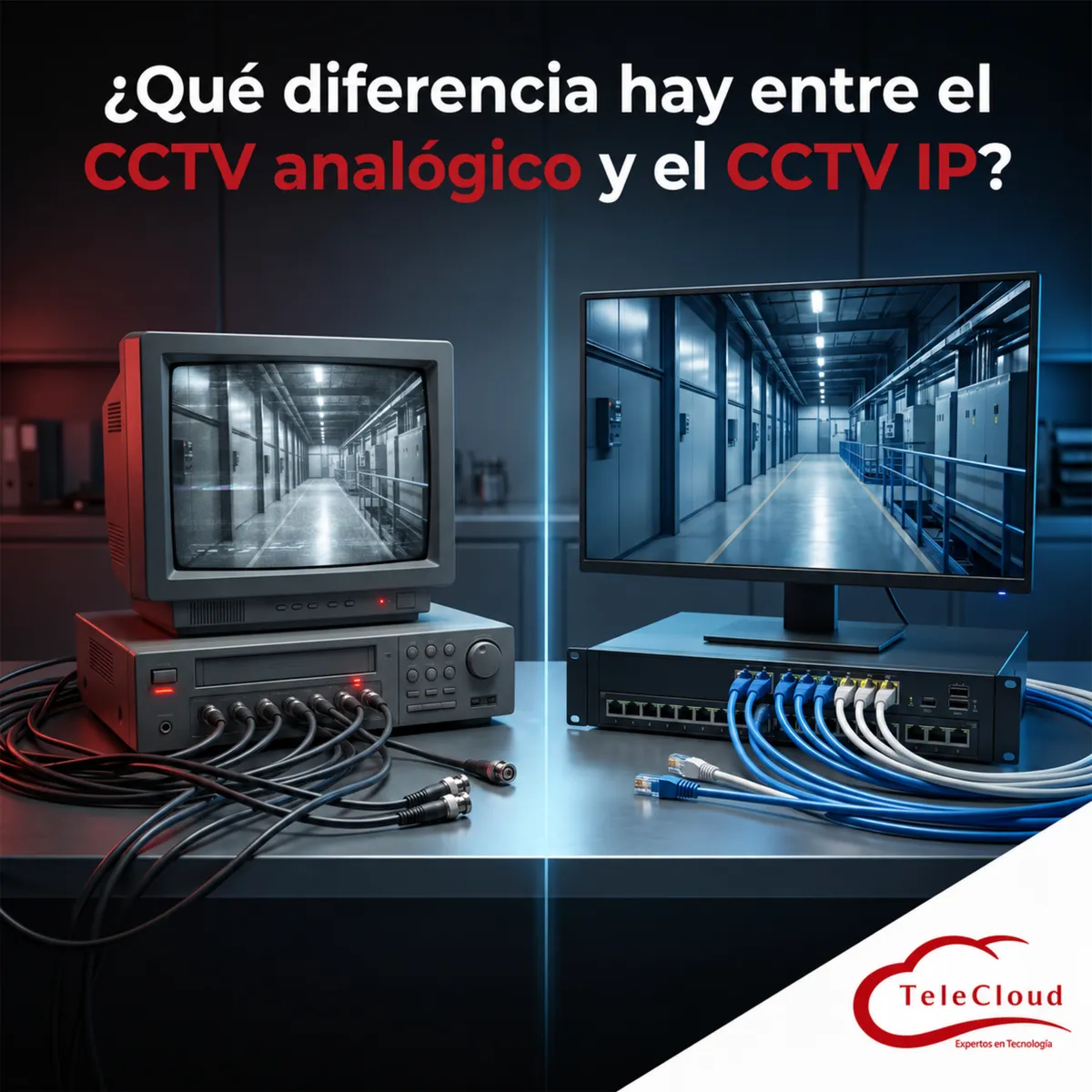
Analog CCTV transmits video over coaxial cable to a DVR with limited resolution. IP CCTV transmits over an Ethernet network to an NVR, with higher resolution, better scalability, and electrical power delivered over the same cable.
The detail your camera system will not give you when you need it most
The clearest difference between an analog CCTV system and an IP one shows up at exactly the moment you need the recording as evidence. An analog camera captures video as a continuous signal that travels over coaxial cable to a digital video recorder, known as a DVR, which converts and compresses it before storing it. That conversion reduces the available detail, especially in low-light or moving scenes, which is precisely the kind of scene a real incident tends to produce.
An IP camera, by contrast, captures video already in digital format inside the sensor itself and sends it over the Ethernet network to a network video recorder, known as an NVR, without that intermediate conversion. The result is an image with higher native resolution, greater dynamic range in low light, and less loss of detail when zooming into the recording.
In an industrial facility, this difference determines whether you can identify a license plate, a face, or a serial number on a box, or whether all you have is a generic silhouette that is useless as evidence for an insurer or an authority.
Resolution and compression: why analog video pixelates exactly where it matters
The resolution of a traditional analog camera under the most common standard does not exceed the equivalent of standard-definition video, no matter how much your company invests in the rest of the system. There are newer high-definition analog variants that improve on that figure, but they still depend on the capacity of the coaxial cable and the DVR to carry that resolution without loss.
A typical IP camera on the market today operates at resolutions several times higher, and transmits that information compressed more efficiently thanks to encoding standards designed specifically for network video. The practical consequence is that a single well-positioned IP camera covers a wider area at the same level of detail that would take several analog cameras, which in many projects reduces the total number of devices needed to cover your entire plant.
Why sticking with coaxial cabling costs more than it saves today
Cabling is the second difference with a direct impact on operating cost. An analog system requires coaxial cable dedicated exclusively to carrying video, plus additional electrical cabling for each camera, because coax does not carry power. In industrial facilities with cameras spread across buildings, yards, and distant entrances, that means two independent cable runs to every point, with the material and labor cost of pulling each one separately.
An IP system with PoE technology, meaning power over Ethernet, carries video and power over the same network cable. That reduces material and installation time, and makes it easier to relocate a camera later without pulling additional cabling. It also simplifies maintenance, because a single cable type covers the whole installation instead of two separate cabling systems that have to be documented independently.
PoE and Ethernet cabling: power and video over the same cable
PoE power delivery has distance and wattage limits that we define according to the camera model and the type of switch feeding it. For industrial installations with longer distances between the switch and the camera, extenders and higher-power switches solve that limit without installing a local power source at every point.
At TeleCloud we design the structured cabling and the network supporting this type of installation as part of the same project, so your video surveillance system is integrated into your general network infrastructure rather than sitting as an isolated network nobody else manages.
That integration also makes preventive maintenance easier. A technician reviewing your data network can immediately spot whether a camera lost its connection or a switch is overloaded, instead of waiting for someone to visually notice that a camera stopped recording days ago.
The ceiling an analog DVR imposes when your plant grows
An analog DVR has a fixed number of camera inputs, generally between four and thirty-two, and a storage capacity defined by the drive size it supports. When your plant grows and you need to cover a new area, the usual option is replacing the entire DVR with one that has more inputs, because the original unit already hit its physical limit.
A network-based NVR system scales differently. As long as your network infrastructure has capacity available, adding cameras does not require replacing the central recorder, and in many cases storage is distributed across several units instead of depending on one. That architecture follows your plant as you add shifts, production lines, or covered area, without forcing you to restart the video surveillance investment from scratch every time you add a coverage point.
NVR and scalability: how many cameras each system supports and how it grows with you
The way an IP system grows also makes it easier to distribute cameras across your company's different locations under a single monitoring platform, something an analog system cannot do without additional equipment dedicated to remote transmission. If your company has more than one plant or branch, that means viewing every camera from the same control point instead of managing independent systems that do not talk to each other.
What we evaluate before recommending a migration from analog to IP
Migrating from an analog system to an IP one does not always mean replacing the entire installation in one move. Before proposing a project, we review the condition of the existing cabling, the current location of each camera, the coverage your operation actually needs, and the budget available for the first phase.
In facilities with coaxial cabling in good condition, encoders can convert the analog signal to network format and let you integrate your existing cameras into a modern management system while the gradual replacement of the oldest equipment is planned. That spreads your investment over time instead of demanding a single outlay to renew the entire plant at once.
With more than twenty years of experience in telecommunications infrastructure and certifications across the sector's leading brands, we design every video surveillance project around the real size of your facility, whether that is a manufacturing plant, a hospital, a hotel, or an educational campus.
Real migration costs: what gets reused and what gets replaced
In most projects, the existing network cabling and the switch infrastructure with enough capacity are reused unchanged. What normally gets replaced first are the cameras at the highest-risk points, such as vehicle entrances, loading docks, and exterior perimeters, while the rest of the installation migrates in later phases according to the budget available each year.
Frequently asked questions
Can I use my current coaxial cabling if I decide to migrate to IP cameras?
In some cases yes, using encoders that convert the analog signal to network format, although the final quality is still limited by the original resolution of the analog camera connected. It is a useful option for extending the life of your installation while you plan the definitive replacement in phases.
How many IP cameras do I need to cover the same area my current analog system covers?
It depends on the resolution and angle of each camera, but in most projects a well-positioned IP camera covers an area equivalent to several analog cameras, thanks to its higher resolution and dynamic range. That is why the final device count is usually lower than what you had before, even as actual coverage increases.
Does migrating to IP CCTV require replacing my entire data network?
Not always. We evaluate whether your current network has enough capacity to support the additional video traffic, and if adjustments are needed, we integrate them as part of the same video surveillance project.
Do you need a network diagnosis?
The TeleCloud team evaluates your current infrastructure and proposes solutions adapted to your industrial operation.
Schedule free diagnosis