
Telecommunications and Industrial Security: What Your Operational Continuity Plan Must Include
A complete operational continuity plan must cover three specific technology components: electrical continuity during power outages, network redundancy, and technical support with a guaranteed response time.
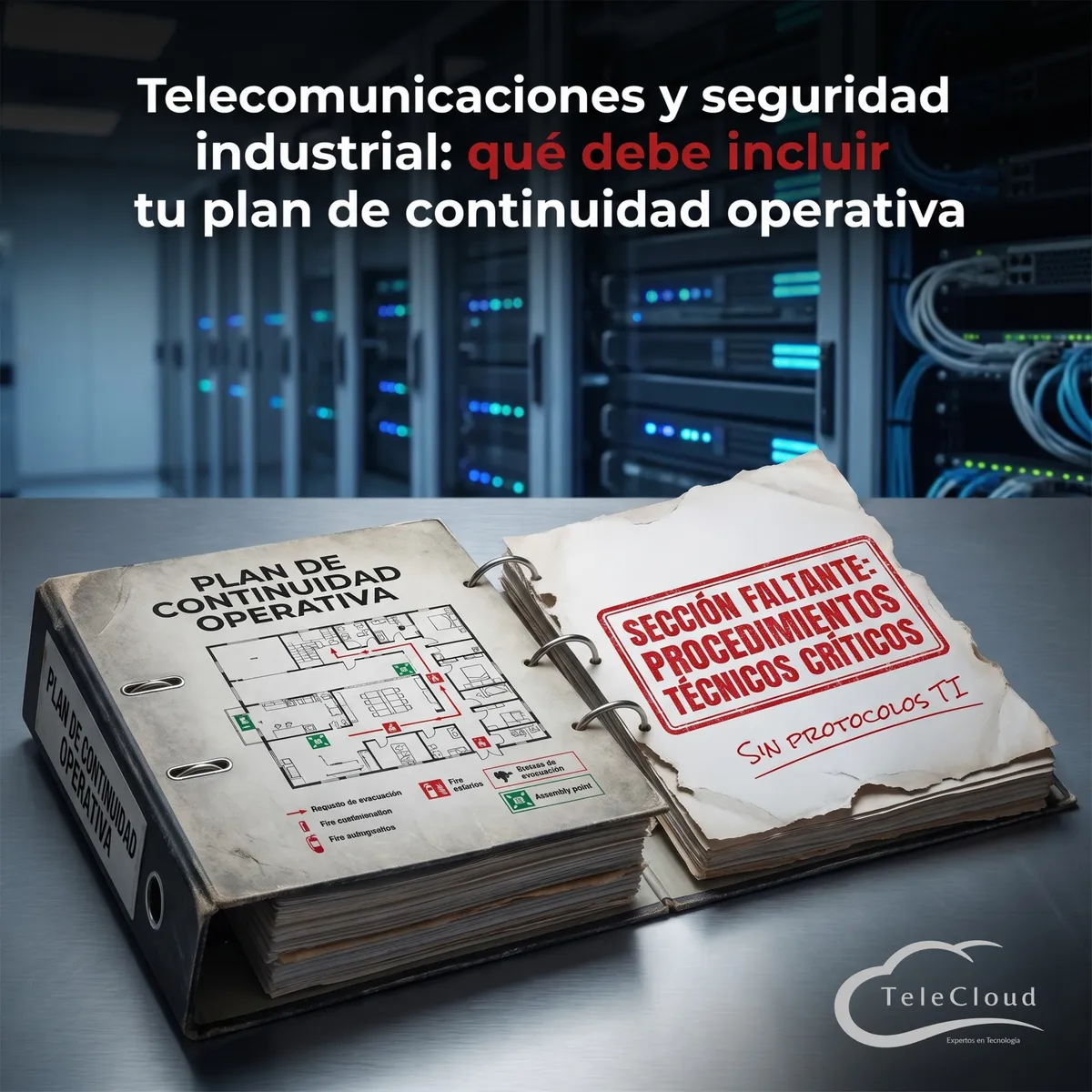
A power outage lasting just a few minutes stopped the production line, and when leadership asked to activate the operational continuity plan, the document that existed only covered evacuation protocols and physical security. No one had planned for what would happen to the network systems, the security cameras, or internal communications during the interruption. The continuity plan existed on paper, but it didn't cover the part of the operation that today depends entirely on technology infrastructure.
Why most continuity plans ignore network infrastructure
Operational continuity plans are usually written by the physical security or HR department, with evacuation protocols, emergency routes, and communication with authorities. That part is necessary, but it leaves out something just as critical today: what happens to the network, the cameras, access control, and internal communications when an incident occurs, whether it's a power outage, a connectivity failure, or a security event.
The three components a complete technology continuity plan must cover
Electrical continuity: properly sized UPS units and generators
Without electrical continuity, a power outage simultaneously stops network systems, CCTV cameras, and access control, right at the moment they're needed most. The plan must specify which critical equipment is backed up by a UPS, for how long, and when a generator kicks in if the outage extends beyond that.
Network redundancy so a single failure doesn't stop all communication
A network with no redundancy depends on a single connection point: if that point fails, all of the plant's communication stops at once. A redundant network keeps critical communication running even if the primary link fails, while the root cause gets resolved.
Technical support with a documented response time
A continuity plan with no guaranteed response time in writing depends on the vendor's goodwill at the moment of the incident. The plan should specify exactly how long technical support takes to respond to a critical failure, not just assume they'll "respond quickly" when it happens.
How to audit whether your current plan actually covers these three points
Review your current continuity plan and look explicitly for these three components: if they don't appear with a clear procedure, your plan protects people's physical safety but leaves unprotected the technology infrastructure that sustains much of the operation today. At TeleCloud we build in UPS, redundant networks, and continuous technical support with a documented SLA, the three services that sustain a real technology continuity plan.
Frequently asked questions
Does my physical security continuity plan already cover the technology side?
Almost never. A physical security plan focuses on people and facilities; technology continuity requires its own specific procedure for power, network, and support.
How often should a technology continuity plan be reviewed?
At least once a year, and always after any significant infrastructure change, such as a plant expansion or the addition of new critical systems.
What document should I require from my telecom provider regarding response times?
A documented SLA (service level agreement) in writing, with a specific response time for critical failures, not just a verbal mention that support is available.
Do you need a network diagnosis?
The TeleCloud team evaluates your current infrastructure and proposes solutions adapted to your industrial operation.
Schedule free diagnosis