
Why Physical Security (CCTV, Access Control) and Cybersecurity Must Live in the Same Ecosystem
CCTV and access control systems share a network with production equipment. Without segmentation and integration, every connected physical device is a potential attack vector. Converged management eliminates that blind spot.
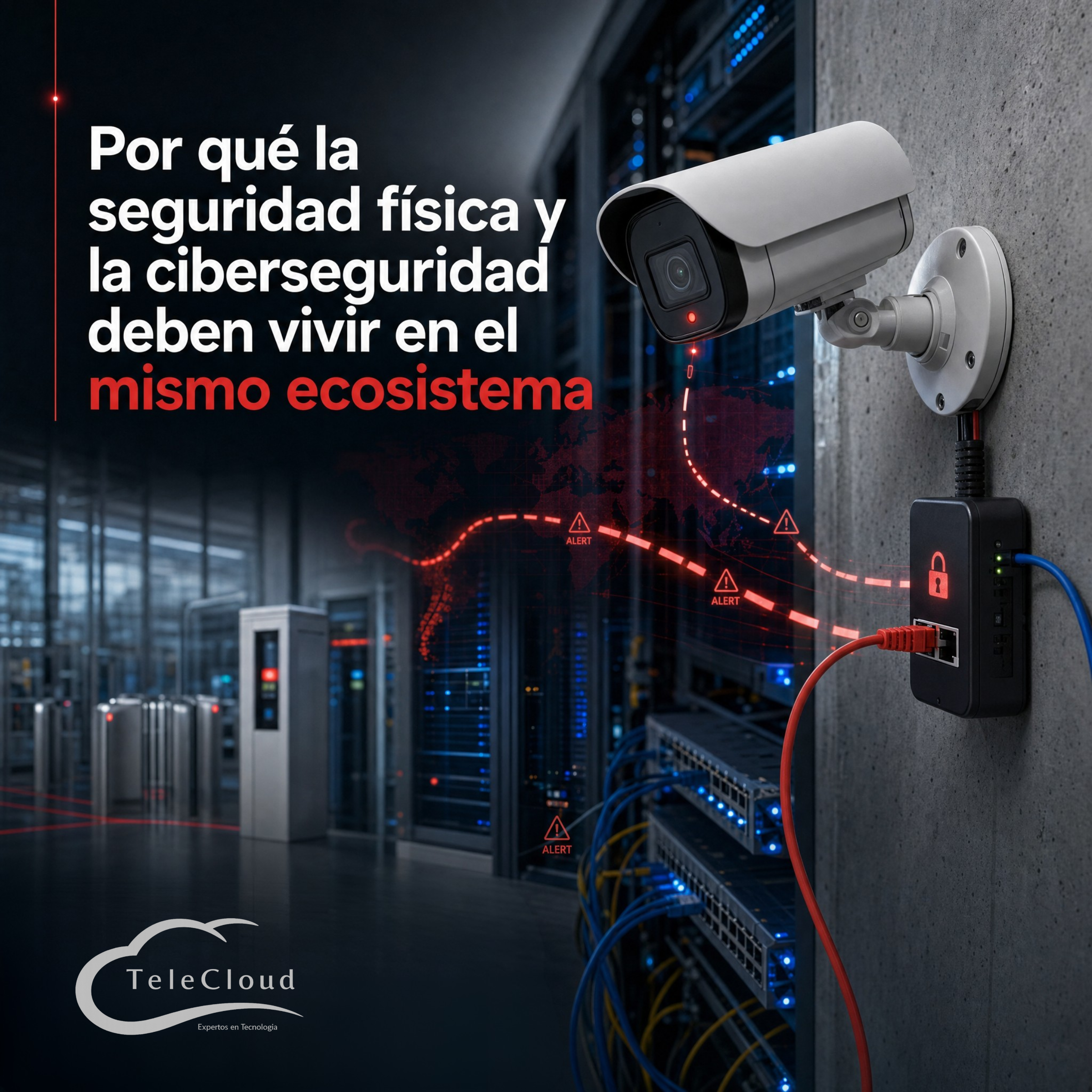
Industrial cybersecurity reports from the past three years document a pattern that repeats across manufacturing plants in Latin America: the point of entry for the attack was a physical security device, an IP camera or access control reader, with unupdated firmware and factory credentials, connected to the same network as the production systems. According to the Dragos report on the state of OT cybersecurity in 2023, the average recovery time for a manufacturing plant after a ransomware incident on its industrial network exceeds two weeks. In the automotive sector, where production commitments with OEM clients are contractually binding, that downtime generates economic and reputational consequences that go far beyond the direct operational cost.
Why physical security devices are today the most exploited attack vector in industrial environments
IP cameras and access readers: connected to the network, managed like office hardware
The majority of CCTV and access control systems installed in industrial plants between 2015 and 2022 operate with firmware that has not received a single update since commissioning. Their access credentials are the factory defaults. They are connected to the same network as production servers because at the time of installation nobody designed a specific segmentation architecture for them.
For an external attacker, a public catalog of IP camera vulnerabilities is sufficient to identify the point of entry within hours. Vulnerability databases such as CVE document dozens of active exploits for the camera and access reader models most commonly installed in Mexico. None of those exploits requires advanced skills to execute.
The physical perimeter is no longer the boundary of the threat
The concept of perimeter security, in which the plant is protected because its doors are closed and its access points are monitored, ceased to be sufficient the moment the first physical device received an IP address. From that instant, the plant's perimeter extended to any network to which that device can connect.
An access control system with known vulnerabilities and without network segmentation can be the entry point for an attacker who never needed to pass through the security booth or approach the facilities physically.
IT, OT, and physical security convergence: the model that modern industrial plants cannot manage separately
Three domains on the same infrastructure, with risks that propagate between them
IT (corporate systems), OT (production control systems), and physical security (CCTV, access control, alarms) have converged onto the same IP infrastructure. That convergence delivers real operational benefits: centralized visibility, unified management, and coordinated incident response. But it also has a direct consequence that few plants have resolved: an incident in any one of the three domains can propagate to the other two if there is no active segmentation and monitoring between them.
Ransomware that enters through an IP camera can move laterally toward production servers if both devices share the same VLAN. An attacker who compromises an access reader can use those credentials to attempt authentication on corporate network systems if user directories are not separated. These scenarios are documented in real incident reports from the manufacturing sector in Latin America.
The measurable cost of managing physical security and cybersecurity separately
The average detection time for an incident in industrial networks without active integrated monitoring exceeds 200 days. In a converged ecosystem with event correlation across all three domains, that time is reduced to minutes. That reduction in detection time determines whether the team resolves the problem within a shift or whether the plant remains paralyzed for days, triggers penalty clauses with OEM clients, and accumulates recovery costs that far exceed the investment in prevention.
How to build a security ecosystem with no blind spots between the physical and digital worlds
Network segmentation: the mandatory first step before any additional technology
Before implementing any monitoring or detection solution, the network architecture must place physical security devices in their own VLAN, isolated from the OT network and the corporate network. This segmentation ensures that a compromised device, whether a camera, a card reader, or an alarm panel, has no direct access to production control systems or business information.
Segmentation also enables the definition of specific firewall policies for each domain's traffic: which systems can communicate with the cameras, at what times, and using which protocols. Without those policies in place, any physical device connected to the network is potentially a bridge to critical systems.
Centralized monitoring: correlating physical and digital events in real time
A unified management system that correlates physical security events with network anomalies can detect attack patterns that neither system would identify in isolation. Physical access to the server room at 3:00 AM followed by unusual network traffic from that location is an alert signal that an integrated system can correlate in real time and automatically escalate to the response team.
This correlation capability makes it possible to detect the chain of events that precedes an incident, rather than reacting after the damage is done. Most industrial attacks follow a recognizable sequence: reconnaissance, lateral movement, privilege escalation, execution. An integrated system can identify that sequence before it reaches the execution stage.
Identity and access management: the link between physical credentials and digital permissions
Modern access control systems allow a worker's physical credential to be linked to their digital network permissions. When someone leaves the organization and their physical access credential is revoked, their network permissions are revoked simultaneously and automatically. When the system detects access to an unauthorized zone, it can automatically restrict that user's digital permissions until an administrator reviews the event.
This level of integration turns access control into an active layer of cybersecurity with autonomous response capability, and it ceases to function solely as a periodic record of entries and exits.
The protocol we use to integrate both worlds at TeleCloud
At TeleCloud we design converged security ecosystems that begin with a simultaneous diagnosis of the network infrastructure, the CCTV and access control systems, and the OT architecture of the plant. The diagnosis identifies all physical devices connected to the network, assesses their level of exposure, and defines the segmentation policies appropriate for each domain.
The result is a documented architecture that eliminates blind spots between the three domains, establishes traffic policies between zones, and defines incident response procedures for events involving physical and digital assets simultaneously. Implementation is carried out in phases, prioritizing the highest-risk devices, without interrupting plant operations at any point in the process.
Frequently asked questions
Can existing physical security systems be integrated without replacing them?
In most cases, yes. The first step is to segment the physical devices into their own VLAN and change the default access credentials. From there, integration with a centralized monitoring system can be done gradually, starting with the highest-risk devices. Hardware replacement is only necessary when the manufacturer no longer issues firmware updates for that model.
What standards apply to the integration of physical security and cybersecurity in industrial plants in Mexico?
The IEC 62443 standard covers the security of industrial automation systems, including physical devices connected to OT networks. For plants in the automotive sector, cybersecurity requirements from the leading OEM manufacturers operating in Mexico include specific controls over physical and logical access to production systems, which must be documented and audited periodically.
How long does it take to implement an integrated security ecosystem in a medium-sized plant?
An integration project for physical security and cybersecurity in a medium-sized plant, with between 50 and 300 connected devices across cameras, access readers, switches, and OT equipment, takes between eight and sixteen weeks from diagnosis to full system operation. The first phase, which includes network segmentation and credential changes, can be completed in two to four weeks and has an immediate impact on the plant's risk level.
Do you need a network diagnosis?
The TeleCloud team evaluates your current infrastructure and proposes solutions adapted to your industrial operation.
Schedule free diagnosis