
What Does IT/OT Convergence Mean and How Does It Affect Your Plant Network?
IT/OT convergence is the integration of the corporate data network with the operational technology network that controls plant machinery, so both share infrastructure, visibility and security policies under a single design.
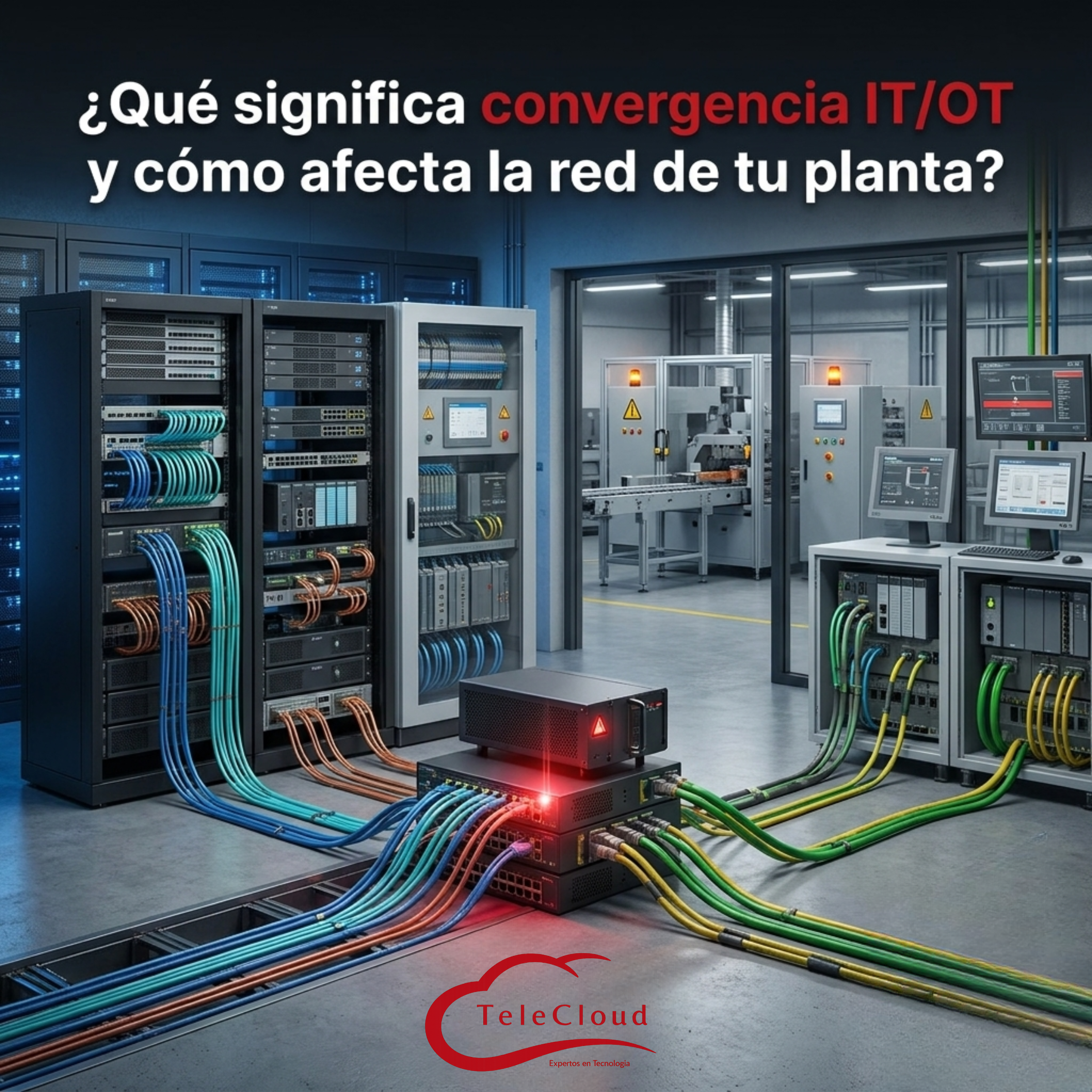
On a Tuesday morning, the production line of a plant in the Bajío region stops without any prior alarm. The IT department checks the servers and reports that everything is operating normally. The maintenance department checks the equipment and reports that the machinery is in good condition. For four hours nobody finds the cause, until someone discovers that a security update applied over the weekend saturated the segment where the floor controllers live. Each area was right about its own territory, and the problem lived exactly on the border that neither of them administers.
The Two Networks That Coexist in Your Plant and Almost Never Talk to Each Other
What IT and OT Mean in Operational Terms
Information technology, known as IT, is the world of email, servers, the administrative system and office computers. Its priority is data confidentiality, and a maintenance restart in the middle of the afternoon is a manageable inconvenience. Operational technology, known as OT, is the world of controllers, sensors, operator interfaces and the machines that produce. Its priority is availability, and a restart in the middle of the afternoon means a production stoppage with a cost per minute. Both networks pursue legitimate objectives that come into direct conflict when they share infrastructure without a design that accounts for it.
Why the Border Between Them Stopped Existing
For years those two networks lived completely separated, and that separation worked as protection. Modern machinery changed that condition: new equipment arrives with factory connectivity, reports telemetry, receives manufacturer updates and feeds the production dashboards that management wants to see in real time. Each of those requirements opens a connection between the floor and the corporate network. Convergence has already happened in most Mexican plants, with the difference that in some it happened by design and in others it happened by accumulation, one piece of equipment at a time, without anyone documenting the result.
The Three Risks of a Convergence That Happened Without Design
Office Traffic Competing With Floor Control
When both worlds share the same network segment without segmentation, administrative traffic competes with control traffic. A backup transfer, a video call or a massive update can consume the bandwidth a controller needs to receive instructions within its time window. Industrial protocols tolerate very little latency and were not designed to negotiate priority with corporate email. The symptom that reaches management is an intermittent stoppage that nobody manages to reproduce, because it depends on what else was happening on the network at that instant.
The Attack Surface That Reaches the Machinery
Without segmentation, a compromised device in the administrative area has an open path toward the plant controllers. That is the scenario that turns a security incident into a production stoppage, because OT systems usually run software the manufacturer no longer updates and that cannot be patched without stopping the line. The plant inherits the worst of both worlds: the exposure of a connected network and the fragility of equipment that does not allow frequent maintenance. Segmentation and traffic control between zones is what prevents a malicious email in the offices from ending up stopping a production line.
Nobody Owns the Border
The organizational risk weighs as much as the technical one. In most plants, IT is responsible for the corporate network and maintenance is responsible for the machinery, and the stretch where both connect does not appear in either org chart. That gap shows up at the moment of failure, when each area demonstrates that its territory is in order and the problem persists. Defining who designs, administers and monitors that border is a management decision that precedes any equipment purchase.
How to Design a Converged Network That Does Not Stop Production
Segmentation With Zones and Conduits
The design principle consists of dividing the network into zones according to their criticality and explicitly controlling the traffic that passes between them. The production floor is separated from the administrative network, and between the two a control point is established that allows only the necessary traffic, in the necessary direction. Production dashboards and telemetry continue to reach management, now through a defined and monitored path. This architecture allows a failure or an incident on the office network to be contained before it reaches the controllers.
Visibility Into What Happens on the Industrial Segment
A good portion of plants cannot state with certainty which devices are connected to their floor network, because the incorporation happened over years and through different vendors. The first deliverable of a convergence project is the real inventory of connected assets and of the traffic they generate among themselves. That map usually reveals connections nobody remembered: service links from a machinery vendor, equipment with remote access left open from a previous installation and protocols running without control. Visibility precedes any protection measure.
Availability as a Design Criterion
An industrial network is designed assuming it will fail and that production must continue. That translates into redundant paths, equipment capable of operating in the temperature and vibration conditions of the floor, power backup at the critical points of the network and maintenance windows agreed with production. The frequent error is replicating the office architecture inside the plant, with equipment and criteria meant for an environment where a restart costs nothing. The floor network operates under different physical and operational conditions, and its design must start from them.
At TeleCloud we design and integrate industrial IT/OT networks for companies in manufacturing, banking, government, hospitals, hotels and education, with more than twenty years of experience, Cisco, Fortinet, Avaya and Huawei certifications, nationwide coverage from our base in Querétaro and certified support. We start with the inventory and the real traffic map of your plant before proposing any equipment. Learn about our approach at https://telecloud.com.mx
Frequently asked questions
Does IT/OT convergence mean merging everything into a single flat network?
The opposite is true. Converging means both worlds share infrastructure and visibility under a design with separated zones and controlled traffic between them. A flat network where everything sees everything is precisely the scenario that lets an office incident reach the plant controllers.
Can I apply the same corporate security policies to the plant network?
They require adaptation. Corporate policies assume a device can be restarted or patched whenever needed, and in the plant those actions stop production. OT protection relies on segmentation, traffic control and monitoring, with maintenance windows agreed with the production area.
Where should I start if my plant already connected equipment without a plan?
With the inventory of connected assets and the map of the real traffic among them. That diagnosis reveals what exists, which connections are in place and which should not be, and it is the basis for designing segmentation. Buying equipment before having that map usually solves a symptom and leaves the underlying problem intact.
Do you need a network diagnosis?
The TeleCloud team evaluates your current infrastructure and proposes solutions adapted to your industrial operation.
Schedule free diagnosis